Universities cannot collaborate while their systems reward competition, higher education leaders warn
At the 4th USAf Higher Education Conference, two vice-chancellors confronted the distance between the sector’s commitment to partnership and the institutional rules that keep universities apart.
Universities cannot build a shared future while maintaining systems that reward competition, obstruct student mobility and make it easier for academics to work alone than across institutional boundaries. Collaboration may be a familiar promise in higher education, but its practical test lies in changing the rules that frustrate it.
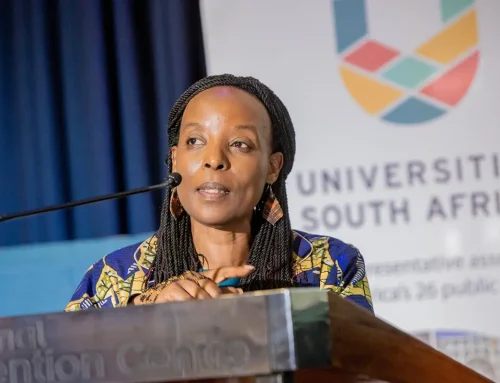
That contradiction dominated the panel on “Sustainability of Higher Education through Collaboration” on Thursday, 8 October 2026, Day Two: Reimagining Universities, at the 4th Universities South Africa (USAf) Higher Education Conference. The event took place from 7 to 9 October at the Council for Scientific and Industrial Research (CSIR) International Convention Centre in Pretoria under the overarching theme “Co-Creating a Resilient Future”.
Professor Anthea Rhoda, Deputy Vice-Chancellor: Academic at the University of the Free State, argued that university sustainability extended beyond financial viability to include curriculum relevance, research capacity and public trust.
Professor Thenjiwe Meyiwa, Vice-Chancellor and Principal of the University of Mpumalanga, challenged institutions to establish partnerships that delivered measurable results rather than merely signing agreements. The discussion, chaired by Professor Francis Petersen, Vice-Chancellor and Principal of the University of Pretoria and chairperson of the Universities South Africa (USAf) board, exposed the bureaucratic restrictions, institutional competition and academic incentives that continue to undermine meaningful collaboration across South Africa’s higher education sector.
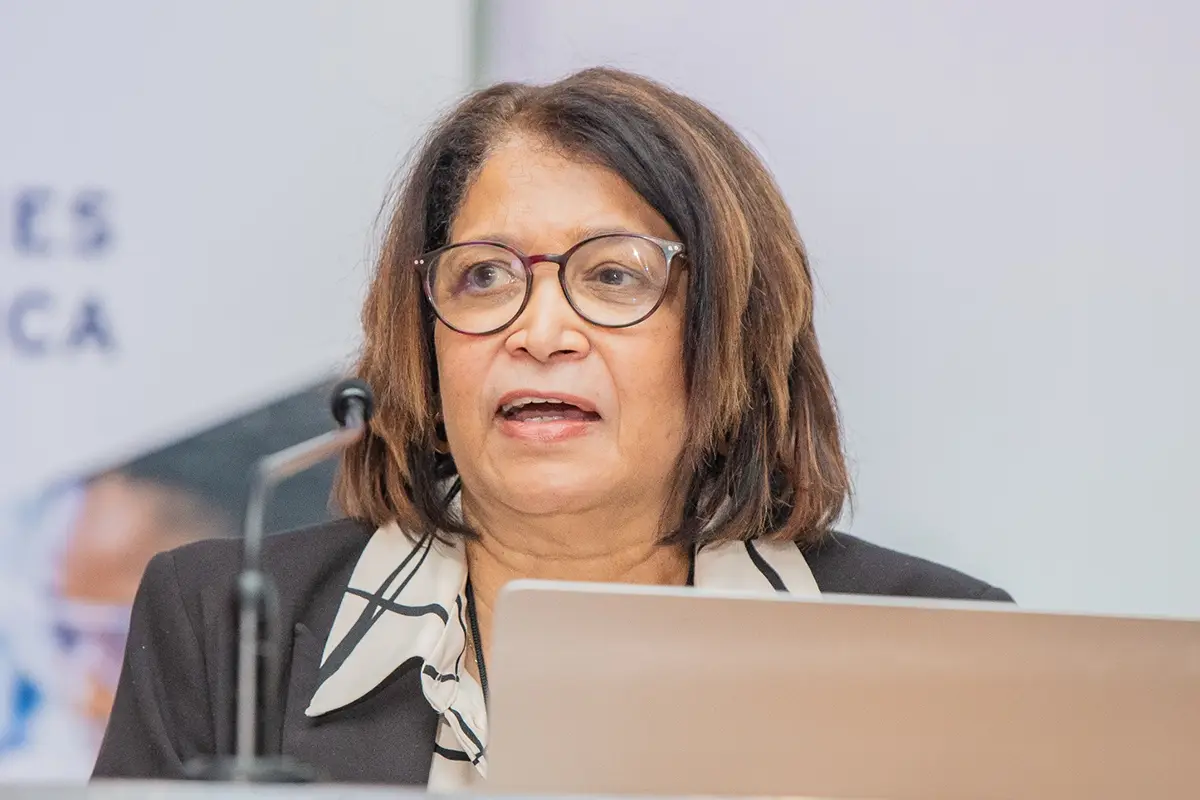
Professor Anthea Rhoda, Deputy Vice-Chancellor: Academic at the University of the Free State, speaks during the panel on Sustainability of Higher Education through Collaboration at the 4th USAf Higher Education Conference, CSIR International Convention Centre, Pretoria, 8 October 2026.
Sustainability begins with the academic project
Rhoda argued that universities could not define sustainability by their balance sheets alone. Relevant curricula, adequate research capacity, skilled academics, trustworthy relationships, secure digital systems and ecological responsibility were equally important to sustaining the academic project.
She asked universities to consider why they collaborated, with whom, and to what end. Partnerships with government, industry and communities, she maintained, should help produce knowledge and address social challenges, rather than merely increase the number of institutional agreements.
Rhoda used the Covid-19 pandemic to illustrate the necessity of collective action. Universities delivering health sciences programmes had to navigate disrupted clinical placements and professional requirements, she recalled. They needed to work together, including with statutory and regulatory bodies, to maintain educational standards and enable students to graduate despite the crisis.
Curriculum relevance offered another test. Drawing on her experience of developing a master’s programme in health data analytics, Rhoda explained that health sciences could not design the qualification alone. Computer science and information systems expertise were indispensable. Such interdisciplinary work required universities to involve employers, professional bodies and communities in deciding what graduates should learn.
She also insisted that partnerships needed reciprocity. Universities could not assume they alone held useful knowledge, or enter communities as though collaboration meant inviting others to endorse academic plans already made. Trust and shared decision-making, she argued, were essential to credible relationships.
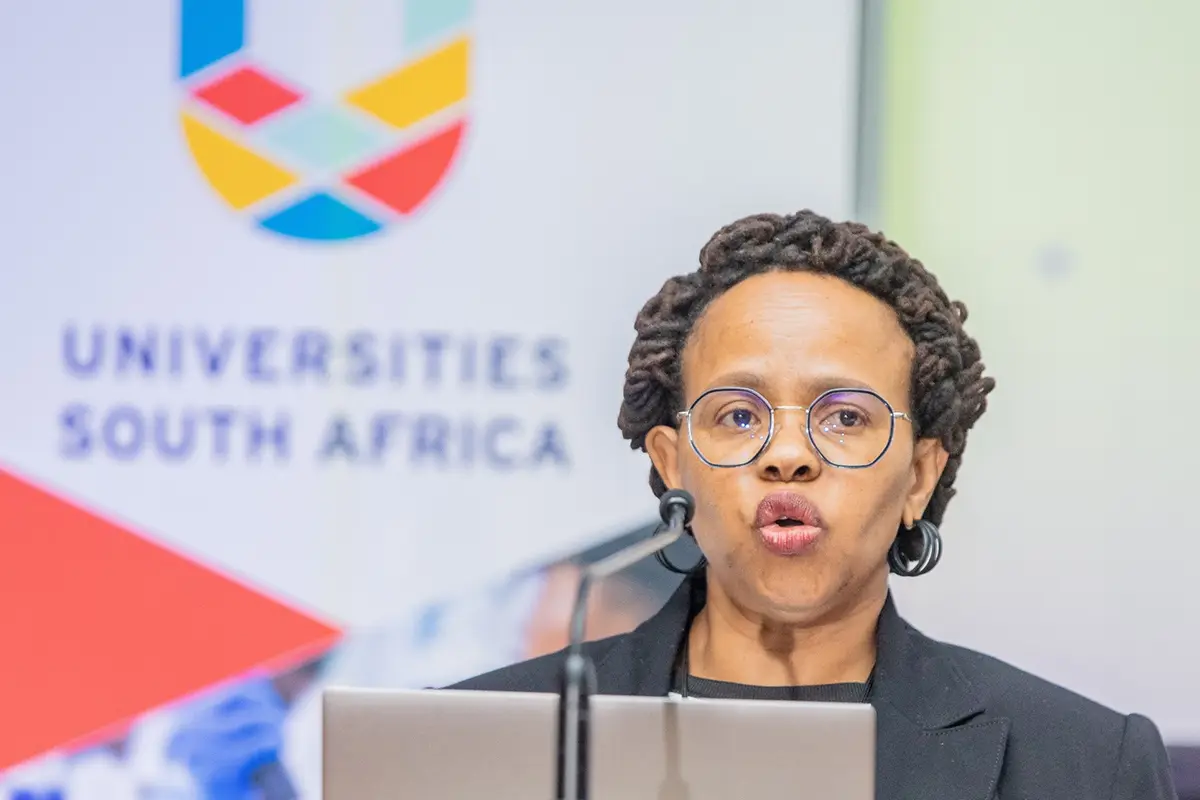
Professor Thenjiwe Meyiwa, Vice-Chancellor and Principal of the University of Mpumalanga, speaks during the panel on Sustainability of Higher Education through Collaboration at the 4th Universities South Africa Higher Education Conference, CSIR International Convention Centre, Pretoria, 8 October 2026.
What can universities build together?
Professor Meyiwa framed the question more sharply: “What can we build together that none of us can build alone?” For younger universities without substantial endowments or long-established infrastructure, she argued, collaboration was not a fashionable option but a condition of institutional growth.
She described the University of Mpumalanga’s initiatives in food security, climate sustainability, and artificial intelligence (AI) education. The university was seeking to connect its expertise with government departments, industry, international partners and farming communities. One project explored hybrid rice production and the use of available land to address food insecurity and create economic opportunities.
Professor Meyiwa presented the projects as examples of what partnerships could make possible, not as proof that every intended outcome had been achieved. She referred to prospective employment opportunities and the contribution of public officials and external partners in overcoming administrative obstacles. The distinction between ambition and delivery is important when public resources and communities are involved.
Professor Meyiwa repeatedly returned to governance. Partnerships, she argued, had to be driven by real programmes, backed by leadership and subject to monitoring and accountability. Memoranda of understanding could not substitute for work that produced measurable results. Her examples demonstrated how effective collaboration brought together knowledge, resources and shared responsibilities to address a clearly defined public problem.
The barriers begin inside universities
During the discussion, Petersen questioned why universities struggled to collaborate across their own faculties and departments while advocating partnerships beyond their campuses. He observed that collaboration often depended on personal relationships among academics rather than on established institutional arrangements capable of sustaining cooperation across disciplines, universities, and other sectors.
Professor Meyiwa located part of the answer in rigid qualifications and university bureaucracy. She questioned why a student could not more easily take modules at different institutions or move between universities without encountering rules that frustrated recognition of prior learning. The systems, she argued, created silos both within and between institutions.
She insisted that these arrangements could be changed because people had created them. Universities serious about mobility and lifelong learning needed to redesign academic pathways, rather than continue to treat individual institutions as self-contained educational destinations.
A delegate from the University of South Africa challenged the sector’s academic incentives, noting that researchers had long been rewarded for working independently, even when complex problems required contributions from multiple disciplines. Collaboration, the delegate argued, would remain marginal if promotion systems and institutional structures continued to recognise individual work above collective achievement.
Professor Rhoda agreed that universities should examine how engaged and collaborative scholarship featured in performance and promotion processes. She cautioned that calling for interdisciplinary work while rewarding narrow outputs would leave the contradiction intact.
Professor Meyiwa added that university rankings and institutional rivalry could become distractions from public impact. She questioned whether prevailing incentives encouraged institutions to solve problems together or to compete for recognition. If collaboration were to matter, she argued, performance measures and governance arrangements would have to reflect it.
Why local partnerships remain difficult
Another delegate from the Tshwane University of Technology asked why universities in Pretoria struggled to demonstrate stronger cooperation despite facing many of the same citywide challenges. He pressed the panellists to explain how local institutions could collaborate before pursuing more ambitious international arrangements.
Dr Phethiwe Matutu, Chief Executive Officer of USAf, raised the related question of collective engagement with industry. Rather than universities or faculties approaching the same businesses separately, she asked how the sector could organise itself around common problems and engage organised industry at an appropriate level.
Professor Rhoda recommended using existing disciplinary networks, university forums and sector structures more effectively. She cited difficulties with funding for students undertaking teaching practice as a challenge shared by institutions, not a problem that could be resolved by a single university acting alone.
She proposed that universities identify common questions, assemble the relevant expertise and engage government or industry collectively. The starting point should be the problem that partners needed to solve, she said, not the desire to add another agreement to an institutional record.
Professor Meyiwa likewise urged the sector to look beyond isolated programmes. She described plans to convene universities in Mpumalanga, including private institutions, to establish priorities for collaboration. However, she also questioned whether competition for funding and prestige continued to drive institutions apart even when they acknowledged shared responsibilities.
Artificial intelligence tests the same promise
The discussion turned to AI when a delegate from the University of Cape Town asked what safeguards universities had introduced to address technological risks while encouraging collaboration, innovation and sustainability.
Professor Rhoda referred to institutional work on assessment, including the need to distinguish acceptable uses of AI according to the level and purpose of students’ work. Her response situated technology within educational judgement rather than treating the acquisition of new systems as proof of progress.
Professor Meyiwa had earlier described an AI learning initiative as an example of collaboration between universities and other partners. But the question from the floor exposed a wider obligation: institutions that share digital tools must also take responsibility for quality, governance and the people affected by their use.
Closing the discussion, Professor Petersen challenged universities to align their institutional practices with their commitment to transdisciplinary collaboration. “You can’t have a different strategy and still have the same incentives,” he warned, arguing that universities needed to reform the systems that continue to reward isolated academic work rather than meaningful cross-disciplinary and cross-sectoral cooperation.
From aspiration to institutional change
The discussion exposed the difficulties universities face in turning commitments to collaboration into changes in teaching, research and community engagement. Rhoda argued that partnerships should address shared challenges, with institutions and their partners agreeing on responsibilities, expected outcomes and how success would be measured. The emphasis, she maintained, should be on cooperation that delivers practical benefits.
Professor Meyiwa reinforced the argument, calling for partnerships built around functioning programmes rather than signed agreements. She urged universities to combine their knowledge, resources and expertise to address problems beyond the capacity of individual institutions, while ensuring that collaboration was supported by effective governance and accountability.
Professor Petersen closed the discussion by challenging universities to reconsider the institutional arrangements that continue to discourage cooperation. His central concern was the contradiction between advocating transdisciplinary approaches and maintaining systems that reward academics for working in isolation. The test he suggested was whether institutions were prepared to change those systems.
Bhekisisa Mncube is a contract writer for Universities South Africa.