‘We have hit the iceberg’: No easy money in sight for South Africa’s universities
“When the Titanic struck the iceberg, no one noticed until it was too late. By the time the ship was sinking, people started running, the orchestra stopped playing, and then they found that there were not enough lifeboats for everyone,” Professor Eugene Cloete told delegates at the 4th Universities South Africa (USAf) Higher Education Conference. “I think that higher education in South Africa, our universities, have hit the iceberg.”

Professor Cloete, CEO of the Cape Higher Education Consortium (CHEC), was speaking online in a session titled “Resourcing Universities”, chaired by Professor Bismark Tyobeka, Vice-Chancellor and Principal of North-West University. With him on the panel were Professor Ellen Hazelkorn, joint managing partner of BH Associates and Professor Emerita at Technological University Dublin and Professor Gerald Ouma, Senior Director: Institutional Planning, Monitoring and Evaluation at the University of Pretoria.
Professor Tyobeka set out the problem: “There is an increasing mismatch between what society expects universities to do and the resources available to universities to do it,” he said. “We should be willing to confront the difficult question and that is can the traditional funding model of the university pay for the institution we are trying to build for the future?”
‘Not just a South African issue’
Professor Hazelkorn, who joined online from Dublin, began by widening the lens. “This conference is happening in South Africa, but this is not just a South African issue, rather it is a much broader issue about higher education, the role of universities and funding.”
The years after the millennium were “arguably the golden age” for universities, she said, but that era is over. More than 80% of young people in much of Europe and North America now go on to some form of post-school education. In Ireland, she said, it is 90% and the question is who gets to pay for a system that size.

“No one wants to pay. People don’t want to pay taxes. They don’t want student loans. The student loan situation in the US and the UK is a big problem, with people carrying long-term loans. And people don’t want to pay fees.
“The free-fees issue, which I know has been an issue in South Africa and elsewhere, is largely a regressive approach. It benefits those who can afford to pay; it is not a progressive approach.
“Just to give the state of play: in Scotland, many of the institutions are in great difficulty. The University of Dundee has been bailed out over the past year by over 120 million pounds. The US higher education sector, which has always been seen as a global crown jewel, so to speak, is now in serious difficulty.”
More money, she said, is not the answer: “Money itself is not going to be the solution. Many of the challenges we are experiencing are structural and systemic, rather than operational, and incremental reforms, making a change here and there, are not going to solve the problem.”

Professor Hazelkorn’s slide: headlines from Europe and North America on the funding squeeze facing universities.
An uneasy settlement
Professor Ouma cautioned against the search for a universally ideal higher education funding model, arguing that funding arrangements are historically contingent rather than permanent solutions. He noted that funding models emerge in response to specific social, economic and institutional conditions, and their effectiveness varies over time as these conditions evolve. As such, their adequacy depends on changing societal expectations, institutional realities and the resources available at a given moment.

After #FeesMustFall, the state took on far more of the cost of making higher education affordable, mainly through the National Student Financial Aid Scheme (NSFAS).
“A lot of funding is going to NSFAS, from R4.1 billion in 2015 to R38.6 billion in 2023,” he said. “But there is a paradox. Even with this strong increase, student debt has increased.”
Money for access has grown while the money for lecturers, laboratories and student support has been squeezed, and he warned against treating the two separately. “Sending students into institutions under growing financial and operational pressure may not be a very wise thing to do. So it is important to finance access and production together.”
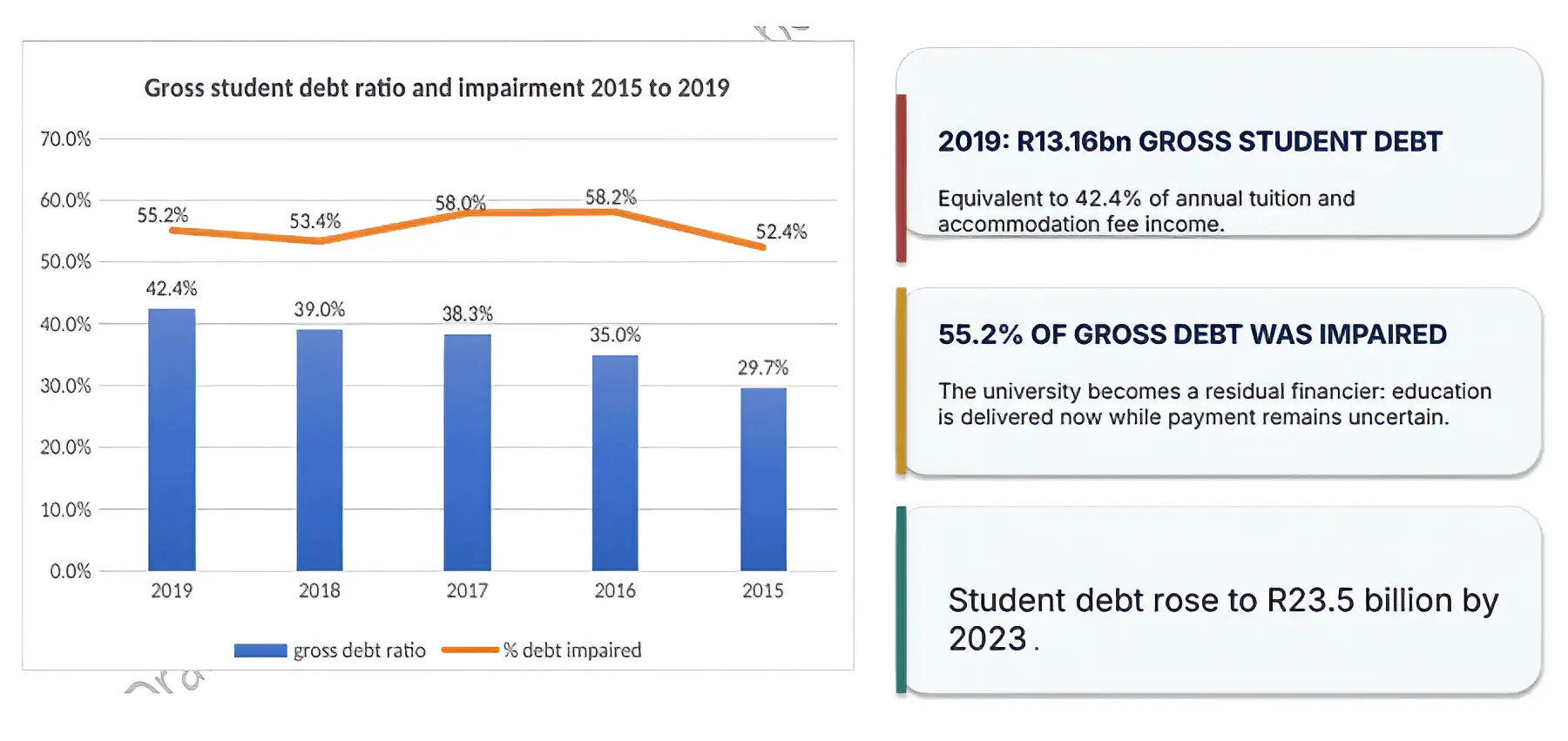
Professor Ouma’s slide: student debt and the share of it impaired between 2015 and 2019.
Professor Cloete was blunter about NSFAS, which he called “the single biggest risk factor at the moment for higher education in South Africa”.
“NSFAS pays for most poor students but the problem is that it doesn’t pay enough,” he said. “If you look, for instance, at the NSFAS allocation for accommodation at most universities, it falls short by between R10 000 and R15 000. So we are setting those students up for failure right from the outset.”
About half of first-year students drop out, he said, and universities share the blame.
“Our assessment practices at South African universities are totally outdated. We set our students up for failure. We say 50% is a pass mark; no one has been able to tell me why that is the case,” he said. “And then we fail students who get 49.5%. So we have perfected an imperfect system, and this is costing the student a lot of money, but it is also costing the government and the taxpayer a lot of money.”
Professor Hazelkorn picked up the point later. “The idea of 50% of your students failing is really a crime,” she said. “What are universities doing to ensure successful outcomes, not just using students as a means of collecting income?”
Earning their own way
Third-stream income, which is money generated beyond core government subsidies and student fees ranges from 2.7% of total income at one university to 54.9% at another, according to Professor Ouma’s figures.
“You saw the university with 2%. That is not enough to hire new academics, build new residences, buy new supplies and those kinds of things.”
Professor Ouma also cautioned that the capacity to diversify income is unevenly distributed. Universities with established research capabilities and reputations are often better positioned to attract research funding. “If you see that an institution is generating a lot of funding from research, of course, capital follows capital. If you don’t have scientific capital, you will not get money. That is an unfortunate thing.”
Professor Cloete has seen diversification work. As Deputy Vice-Chancellor at Stellenbosch University in 2017, when National Research Foundation funding began to dip, he brought institute directors and deans together to find other funders. “At that time, 23% of Stellenbosch University’s funding in this category of third-stream income was international. Seven years later, that grew to 83%,” he said. “That was a deliberate decision to diversify the income streams.”
Patents are another matter. The four Western Cape universities hold some 300 registered patents, and few have been commercialised. “We are good at registering patents, but we are not good at commercialisation,” he said. “So do not think that commercialisation of IP is going to save the university financially.”
Professor Hazelkorn agreed. “Research is a cost, not an income.”
Janine Greenleaf Walker is a contract writer for Universities South Africa.