Youth employability is about possessing appropriate skills and not where the skills are sourced – Professor André Roux, Stellenbosch University
Plumbers and other tradesmen are as important to the economy as professionals, said Professor André Roux, Associate Professor (Emeritus) and Principal Lecturer in Economics at the Stellenbosch Business School, at the inaugural Thought Leadership event of Universities South Africa (USAf) on 2 October.

The gathering explored the growing challenge of school leavers with a Bachelor’s pass but who cannot all be accommodated at universities — a trend with serious implications for youth employability.
“We desperately need plumbers,” he said, adding that it is equally important for tradesmen to acquire management training so they can employ themselves and other people.
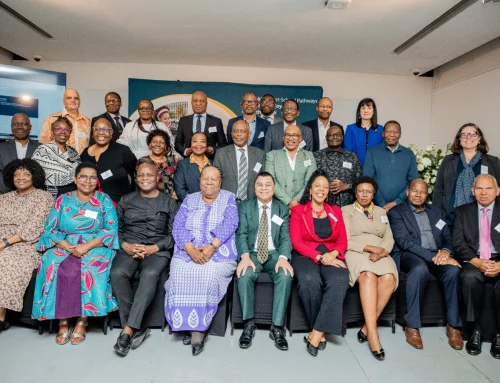
The hybrid event drew 130 participants comprising senior university executives, academics, administrators, representatives from private higher education institutions, TVET colleges, professional bodies, career development organisations, corporate foundations, and education‑focused NGOs.
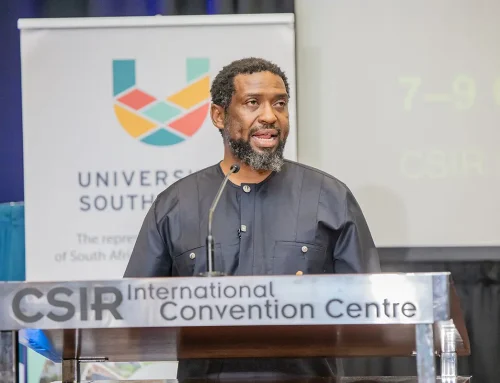
Through the plumber reference, Professor Roux (left, above), who also serves Stellenbosch University as Programme Head for the Postgraduate Diploma in Futures Studies, was illustrating a widespread parental belief that careers rooted in trades such as plumbing or electrical technology are “second‑rate” and unsuitable for their children. Many parents, he noted, prefer to steer their children toward traditional professions like medicine or law, often ignoring the rapidly shifting dynamics of the labour market.
“We need to change that,” Professor Roux urged, calling on society to challenge cultural cynicism and dismantle the stigma surrounding career paths outside the university system.
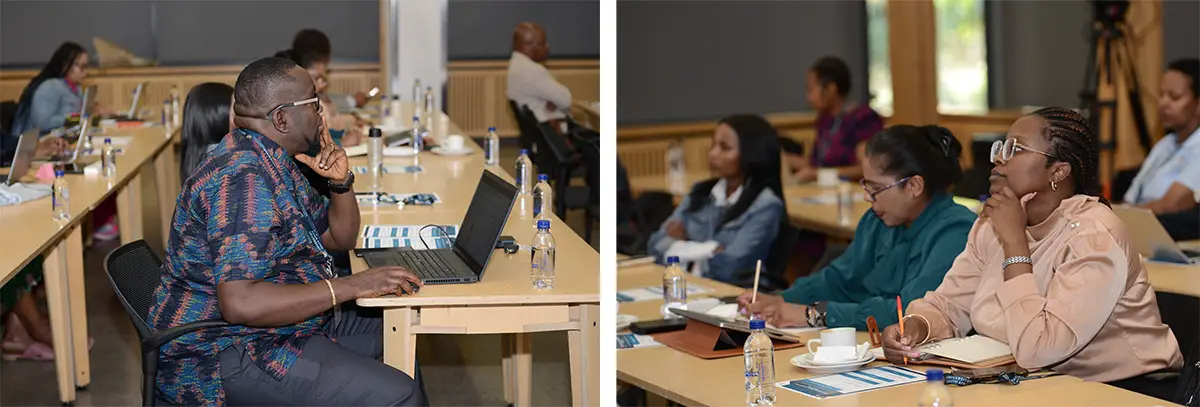
Part of the in-person audience at the Future Africa Campus of the University of Pretoria.
Rising youth unemployment and the NEET challenge
All of this is unfolding against the backdrop of South Africa’s persistently high unemployment rate, which remains above 30%. The problem is particularly acute among young people, given that South Africa has one of the youngest populations globally.
“A large part of our working population is between the ages of 15 and 34,” noted Professor Roux, adding that unemployment figures are climbing, especially among those aged 25 to 29 and 30 to 34.
One of the most pressing concerns, he emphasised, is the growing number of young people classified as NEETs — those not in employment, education, or training. Currently, around 35% of South Africans aged 15 to 24 fall into this category.
When access no longer guarantees opportunity
Professor Roux explained that while participation in education has expanded, this has not translated into lower unemployment. The challenge lies not only in access but in the relevance of the skills learners acquire. He noted that “roughly half of our population above the age of 20 has not completed school, and among those employed, fewer than one quarter work in skilled occupations.”
This mismatch between educational attainment and labour market demand shows that many learners are not being equipped with competencies aligned to areas of economic growth. Instead of becoming a source of economic strength, the youth population is increasingly pushed to the margins of both education and employment. This is not simply about individual transitions failing; it reflects a structural disconnect between education pathways and labour market realities.
Education in a changed economy
He attributed South Africa’s high unemployment to major structural shifts in the economy over recent decades. “There was a time when mining and agriculture, our primary sector, employed many people, even those with limited education. But those times have changed. Mining and agriculture now account for barely 10% of the economy. The tertiary sector, part of the services industry, now makes up close to 70%.”
Yet education often produces skills that do not align with the needs of this transformed economy. Even the services sector, he cautioned, cannot remain complacent in the face of artificial intelligence and the “creative destruction” being ushered in by modern technologies.
Professor Roux pointed to innovations such as the Internet of Things, robotics, biotechnology, nanotechnology, quantum computing, and blockchain. These technologies simultaneously generate new products, jobs, and processes while dismantling existing markets — creating both excitement and anxiety about the future of work.
The Fourth Industrial Revolution (4IR) is reshaping work
To demonstrate how 4IR is reshaping work, Professor Roux used the example of the typewriter — a once‑essential tool now replaced by a multitude of other technical devices. He emphasised that technological advances will affect every sector of the economy, as shown in the examples below.
In education, roles such as librarians, mediocre teachers, and administrative clerks are likely to decline, while demand will grow for learning technology designers, curated knowledge specialists, special‑needs educators, and AI coders for teaching and learning.
In agriculture, traditional positions like pesticide handlers, general farm workers, inspectors, and cooling equipment operators will diminish. In their place, new opportunities will emerge for drone operators, agricultural economists, animal bioscientists, precision farming technologists, and agri‑processors.
In mining, the need for rock drillers and loaders will decrease, replaced by underground drone operators and specialists in re‑mining waste dumps. Similarly, robotics will take over many traditional manufacturing functions.
Professor Roux added: “Cargo and freight agents will become less prevalent, as will painting and coating workers, mechanical crafters, and mould makers. However, we will see growth in digital manufacturing, battery automation, and African market analysts.”
He stressed that these shifts must be understood from a South African perspective, while also noting global trends. Contemporary research predicts that by 2030, up to 47% of workers worldwide — particularly in Japan — will need to transition to new jobs as factory and manufacturing work is outsourced to robots and advanced technologies.
The same disruption is already visible in transport and automotive industries and in the financial sector, where roles such as tellers, accountants, auditors, statistical clerks, and credit analysts are steadily declining.
The informal economy
Professor Roux cautioned against assuming that the 4IR will undermine the informal economy — a sub-sector characterising South Africa, Africa, and many parts of the world. On the contrary, he argued, new roles are likely to emerge within this space. He pointed to opportunities in personal security services, elderly care, home care, and daycare, alongside informal banking and app development to connect traders and service providers.
“My message is that nothing is static. New roles are being defined, redefined, and refined,” he emphasised, with implications for current and future study choices.
It is about the acquisition of appropriate skills
Professor Roux saw the biggest challenge for South Africa as being equipping youth appropriately for today’s labour market, citing the following as the most critical skills:
- Analytical and critical thinking
- Complex problem solving
- Creativity and communication
- Active learning and adaptability
- Resilience and leadership
- Technological design and usage
He explained that while the earlier industrial revolutions focused on physical labour, engineering, and later deep STEM (science, technology, engineering and mathematics) expertise, the Fourth Industrial Revolution demands agility, empathy, and transdisciplinary thinking. These reside in STEM disciplines, now incorporating the Arts to become STEAM disciplines.
The future, Roux stressed, is about integrated competencies: cognitive, human, and technological skills, combined with strategies for continuous learning.
Lifelong learning as an economic imperative
He argued that continuous learning has become essential in a labour market characterised by rapid technological and structural change. Acknowledging that technology is a core competency, he said: “It is not the only one… everybody will need to learn how to re-learn,” emphasising adaptability as a central requirement for long-term survival in the labour market.
He added: “Lifelong learning is no longer a nice-to-have. It has become an absolute necessity,” highlighting the need for education systems to support ongoing skill development through accessible, flexible and relevant learning opportunities.
In an economy where many roles will continue to emerge, shift or disappear, individuals who cannot upskill or reskill will face increasing difficulty maintaining economic participation. This places pressure on institutions, employers and the government to expand opportunities for continuous learning and ensure that such learning is aligned to practical, evolving demands.
Where to source skills
Professor Roux said if the purpose of the USAf dialogue was to address youngsters not in employment, education or training, tertiary education must explain why not everyone will find a place at university and inform them about viable options.
“It’s been repeatedly said that if a young person does not go to university, he or she will not inquire of the Holy Grail, because society has led us to believe that university is the ticket to success.
“We need to amend that narrative and say yes, it certainly is for many people. But it’s not the only ticket to success. The narrative has to consider alternative avenues for those young people finishing school.”
The professor emphasised the imperative of recognising students’ evolving needs. “They want more personalised, student-centric experiences that link to that. Popularity has risen around non-credit-bearing learning and teaching programmes. Massive Open Online Courses (MOOCS) are one well-known example. LinkedIn courses are another. Young people, even graduates and beyond, need to become aware of these.
“We need to be able to say with authority and conviction that university is not the panacea for every single school leaver. There are many good and, in many ways, even more valid alternatives, depending on the profession a young person wishes to pursue.”
The inaugural Thought Leadership event was received very positively, yielding audience comments such as:
- Prof Roux, your presentation is so on point, with digital transformation and 4IR driving so much change for our youth. By the time they graduate, what world of work will they be stepping into? We should look forward to solving the problems highlighted today. The current status quo is clearly not working – Ms Nuraan Davids-Latief, University of the Western Cape.
- Thank you, Prof Roux, for a concise yet intense presentation – there are a lot of takeaways from this -– Wonderboy L (institution undisclosed).
- Prof Roux, Thank you for your well-articulated and thought-provoking presentation on the future of work and workers in South Africa. Your insights into the shifting dynamics of the labour market and the challenges and opportunities ahead were both timely and deeply relevant…The clarity with which you connected global trends to South Africa’s unique challenges and opportunities offered both sobering perspectives and a sense of possibility for action. Your ability to frame these complex issues in an accessible, engaging manner sparked critical reflection and dialogue. It was a privilege to learn from your expertise – Dr Ruth Andrews, University of the Western Cape.
- Excellent points made on TVETs — Ms Meriam Magome, Department of Education, Limpopo.
- Excellent points. The paradigms must shift about TVETs – Dr Shirley Lloyd, Association of Private Providers of Education, Training and Development (APPETD).
- To all the panellists: Thank you for such insightful contributions. Today’s discussion reminds us of the urgency of rethinking pathways across universities, TVETs, community colleges, and the private sector, especially in light of South Africa’s youth unemployment challenge. No single sector can address youth un/employment alone. Collaboration across education and industry is our best way forward. The perspectives shared here will help us shape more inclusive and forward-looking solutions. Our collective task is to ensure that young people not only gain qualifications, but also real opportunities for employability and flourishing. With gratitude – Dr Ruth Andrews, University of the Western Cape.
As the meeting wrapped up, Professor Roux, who presented last, after the other four panellists, responded to Dr Andrews’s comment above: “This, I think, is potentially the most important outcome of this session – the destigmatisation of post-school education and training providers OTHER than universities. This narrative needs to be reinforced by as many “stakeholders” as possible – in a credible fashion.”
And the concluding remarks on the Zoom Chat platform read: “Thank you, USAf, for organising today; I can’t wait for the next topical event,” wrote Mr Willem Mostert, a Stellenbosch-based entrepreneur. Professor Marlé van Eyk, Professor of Marketing in the Faculty of Business and Economic Sciences at Nelson Mandela University, echoed: “Thank you for a very informative session.”
‘Mateboho Green is Universities South Africa’s Manager: Corporate Communications, and Thoriso Kolobe is a Communication Consultant commissioned by Universities South Africa.